


Construction is still too often defined by outdated perceptions. Images of hard hats and high-visibility clothing continue to dominate, masking the reality of a sector that is diverse, increasingly digital and rich in opportunity.
But the industry’s biggest challenge is not simply changing how it is perceived. It is changing how it works.
Despite years of focus, progress on gender balance remains slow. Analysis shows the gender pay gap among engineers has reduced by just 1.1 percent over the past decade, a marginal shift that highlights the scale of the challenge. The most recent data reinforces this. In 2025, the median gender pay gap in engineering stood at 11.6 percent, meaning women continue to earn significantly less than their male counterparts.
To us, that suggests the issue is not simply about awareness or attraction; it is structural.
Changing Perceptions Early
One of the earliest and most persistent barriers we see is how construction is understood in the first place. Research shows that perceptions of career paths are often developed as young as six, which makes early engagement critical. If those early assumptions are narrow or outdated, they can influence decisions long before children actively start thinking about their future.
Through our work as STEM Ambassadors, we have both had the opportunity to engage with students across schools and communities, and the impact of that early exposure is clear. When construction is presented as it really is – a sector that combines engineering, technology and problem solving – perceptions begin to shift quickly.
We have seen first-hand how curiosity builds when the full range of opportunities is explained. Conversations move from assumptions to questions. Students want to understand routes into the industry, what different roles involve and where those careers can lead.
Programmes such as STEM Outreach and Apprenticeship Schemes are already helping to reshape how construction is perceived. They are exposing the industry to a broader group of young people and making it more accessible. For us, this is not just a professional responsibility but a personal one, too. It is about ensuring the next generation has access to accurate and balanced information so they can make informed decisions about their future.
However, while changing perceptions is essential, it is only the starting point.
An Evolving Industry Needs Diverse Talent
Construction today is undergoing rapid transformation. Advances in digital tools, such as 3D modelling, digital construction rehearsals and artificial intelligence are redefining how projects are delivered. This shift requires a different mix of skills, and with that comes a need for a broader and more diverse talent pool.
As industry professionals, we have a responsibility to promote civil engineering as an inclusive and forward-thinking profession, encouraging participation from both males and females. From our 30+ years of combined experience, it’s clear that diverse teams deliver better outcomes. Bringing together different perspectives strengthens problem solving, encourages innovation and ultimately leads to more effective project delivery. Over time, we have seen that creating an inclusive environment, where people feel valued and supported, results in stronger teamwork and better performance. Providing equal opportunities and fostering an inclusive environment where individuals feel valued leads to more rewarding and successful results.
But to achieve that, the industry needs to look beyond traditional ways of attracting talent. It needs to position itself as the forward-thinking, opportunity-driven sector that it has become.
Progress is Happening, But Not Consistently
There are encouraging signs of change. The increasing representation of women in leadership roles is helping to challenge traditional norms and inspire the next generation. The appointment of Julie Wood as the fourth female President of the Institution of Civil Engineers (ICE) for the 2026-2027 term, reflects positive progress towards greater equality and inclusivity.
On site, we are also seeing more collaboration between male and female colleagues, which is encouraging. There is a growing sense of teamwork, acceptance and mutual support that reflects a shift in culture.
At the same time, experiences are not always consistent. There are still moments where outdated assumptions surface, such as raised eyebrows over a female in an engineering role, creating small but noticeable reminders that perceptions have not fully caught up with reality. These moments matter because they shape how inclusive the industry feels on a day-to-day basis. We are hopeful to keep challenging these stereotypes, improving the attitude towards both genders for the best, and we can only grow exponentially from here.

Shifting Attitudes
From our own experience, culture plays a defining role in whether people not only enter the industry but stay and succeed in it.
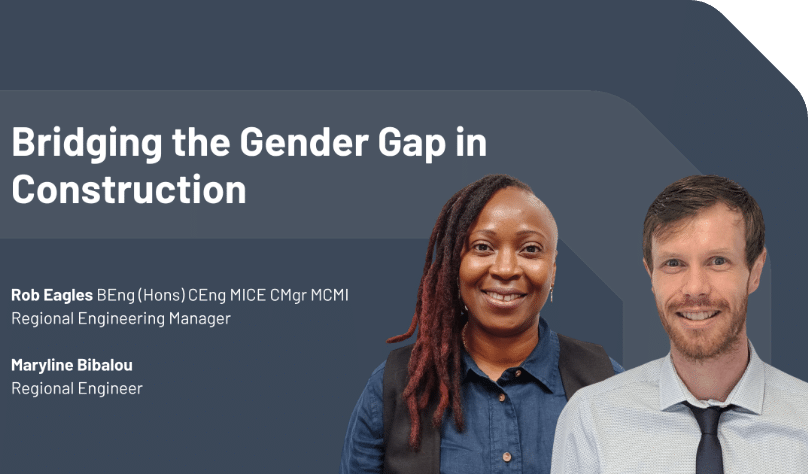
Maryline was fortunate enough to have joined the construction industry 13 years ago with a management team who valued being inclusive, pushing for the same exposure as male counterparts on site. Initial support like this, set the pace for my progression in the industry, as gender was not a showstopper.
In my role as a Lead Reviewer for the ICE, Rob frequently challenges candidates to reflect on the issue of the gender gap, as addressing it is essential for creating a more sustainable and progressive future for our industry. As a parent, it’s imperative to create a space where my daughter has access to accurate and balanced information, enabling her to make informed career decisions.
As we reflect on the gender gap in construction, especially for this year’s Women in Engineering Day celebration, one critical question still needs to be answered. As we continue to encourage more women into construction, are we doing enough to keep them? Retention remains one of the least addressed aspects of the gender gap. Life stages, such as maternity, still present barriers that are not consistently supported, particularly in site-based roles. If the industry is serious about closing the gap, it must move beyond attraction and address the reality of long-term career sustainability.
The construction industry has made progress, and perceptions are beginning to shift; more women are entering the profession and representation at senior levels is improving. But the gender gap in construction will not be solved by awareness alone. It will be solved when inclusive practices are embedded into how the industry operates every day. Because ultimately, the future of construction depends on its ability to access, support and retain the widest possible talent pool. And that means creating an industry where opportunity is not limited by perception but defined by potential
For more information or media enquiries, please email marketing@mgf.co.uk.
Whether you have a question, need a quote, or want to discuss a project, our dedicated team is ready to assist you.