

As Mental Health Awareness Week encourages organisations across the UK to talk more openly about mental wellbeing, it is an important moment for those working in the construction industry to reflect on the working environments we create and the pressures we normalise.
Although discussions around mental health are increasingly encouraged, poor mental health within construction remains, in the CIOB’s words, “a silent crisis”. In their 2025 report, Understanding Mental Health in the Built Environment, they found that 94% of survey respondents had experienced stress in the last year, with 83% experiencing anxiety and 60% depression. More concerning is that over a quarter reported having suicidal thoughts within the last year. Despite the greater awareness, encouragement, and the increased visibility of support mechanisms across the industry, these figures remain mostly unchanged since the CIOB’s 2020 report.
Whilst the continued prevalence of poor mental health and wellbeing within the industry is striking, the most commonly reported reasons are not unexpected, they are entirely recognisable to anyone working within the sector; too much work (71%), time pressure (70%), unrealistic deadlines (69%), poor communication (69%), poor planning (68%) and a lack of clarity around job roles (61%). In my view, these are not isolated personal challenges, but symptoms of the working environment created by how projects are procured, organised, and delivered.
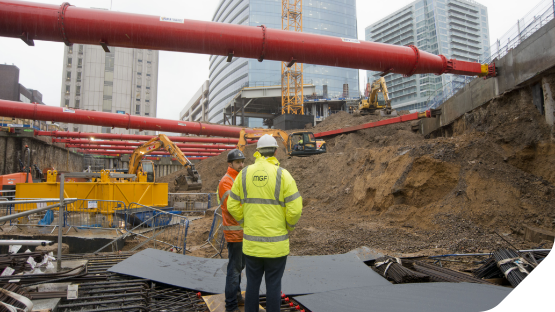
Early in my career, while explaining the fast-paced nature of the role, a senior colleague told me that Temporary Works are often the last thing thought about, but the first thing needed on a project. Now, over a decade later, that still holds true.
The Health & Safety Executive has long linked poor planning, co-ordination, and unclear responsibilities with unsafe outcomes on site. The inevitable time pressure and uncertainty caused by these factors may lead to compromised decision-making and increased physical risk. Less visibly, those same factors also increase the risk to mental health and wellbeing, further affecting judgement and performance.
As a supplier of a wide range of temporary works equipment to the construction industry, MGF pride ourselves on our ability to respond and deliver at a moment’s notice. We are aware that a responsive, helpful supplier can ease pressure for our customers but, whilst reactive situations are inevitable due to the unknowns of working in the ground or within existing structures, persistent reactivity should not become the default if wellbeing is to be protected.
In a reactive situation, there is often a ripple effect of pressure from the project team through to operational teams within the supply chain. At project level, teams wait on answers while the project continues to run and that uncertainty quickly travels across the supply chain, placing pressure on designers, operational teams and site staff alike. Left unchecked, this constant state of uncertainty and time pressure does not just affect programmes and productivity. It contributes directly to chronic stress, anxiety and reduced wellbeing across project teams and the wider supply chain.
Whilst proactivity does not remove pressure, the pressure that exists is more predictable and can be more manageable. With clearer upfront planning and earlier engagement, workloads become more predictable, communication is calmer and more measured, and fewer issues compound at the same time. This provides essential breathing space to manage the reactive challenges that inevitably arise on construction projects. This is most effective through fostering trusted, long-term, collaborative relationships within project teams, including with temporary works designers and suppliers. These conditions support not only safer technical outcomes, but healthier, more sustainable working environments where people are better able to cope with pressure and maintain their wellbeing.
One of the CIOB’s recommendations is for organisations and the wider industry to address the business and working environment that people operate within. That includes tackling workload, time pressure and unrealistic expectations, as well as reviewing payment practices and the way risk is passed through the supply chain. While the report does not describe how projects should be procured in detail, it is clear in linking poor planning, lack of clarity and excessive job demand with poor mental health outcomes.
From a delivery perspective, procurement decisions play a significant role in shaping those conditions. The partners brought into a project, when they are engaged, and the relationships that develop, all influence how information flows and how pressure is managed once work is underway. My sense is that where supply chain partners are genuinely part of the project team, rather than engaged late, planning and communication tend to be stronger. That appears to align closely with the areas CIOB identifies as major contributors to workplace stress.


Improving mental health in construction will not come from a single initiative, and no procurement strategy alone will solve what the CIOB rightly describes as a silent crisis. However, setting projects up more deliberately, with greater collaboration and clearer planning from the outset, can help create more stable working environments. As Mental Health Awareness Week reminds us, if stress, time pressure, poor communication and unclear roles are among the main contributors to poor wellbeing, then the way we procure, organise and support our project teams has to be part of the industry’s response.
Whether you have a question, need a quote, or want to discuss a project, our dedicated team is ready to assist you.