

Modern Slavery
MODERN SLAVERY STATEMENT 2024/25
This statement has been produced to comply with the Modern Slavery Act 2015. It provides details of the steps taken by MGF Ltd, group and associated companies (MGF) during the year ending 30th June 2025 to prevent modern slavery and human trafficking in its business and supply chains.
Introduction
Modern Slavery is a growing global issue with the International Labour Organisation providing the first Global consolidated figure which estimates 40.3 million people in modern slavery globally, and of these, 24.9 million people are in forced labour which includes 16 million in the private sector including construction, manufacturing, mining, utilities, agriculture, forestry, fishing, and domestic work. Due to the increasingly global nature and complexity of supply chains, no industry or sector can be considered immune from the risks of modern slavery.
This is MGF’s seventh published Modern Slavery Statement and as previously reported, we are able to provide full assurance that there is no modern slavery in our own business. In this reporting period we have continued to make progress with our supply chain.
MGF is founded on strong values: our commitment to operating our business in a responsible and sustainable manner is embodied in MGF’s Making Great Futures and RESPECT Ground rules which set out our relationships with our people, our customers, the environment, and the communities in which we operate. This commitment extends to playing our part in eradicating modern slavery and we believe that this will be achieved through a progressive and consistent approach to provision of transparency in our own business and most importantly in our supply chains where we are potentially exposed to the greatest risk.
Key Focus Areas 2025/26
‣ Continue to broaden awareness of the risks of Modern Slavery through provision of training to a wider group of staff within our business
‣ Continue analysis of our supply chain spend to allow effective engagement, building of capacity, provision of transparency and assurance in respect of Modern Slavery
‣ Continue to consolidate supply chain to reduce the number of suppliers and subsequently reduce risk.
This statement was approved by the Board of Directors of MGF Ltd.

Simon Littlewood
Managing Director, MGF Ltd
15/12/2025
Our Business
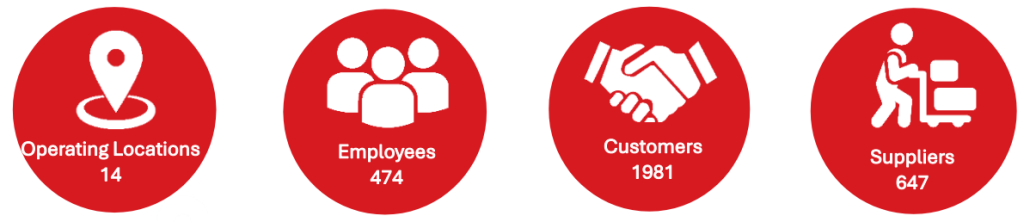
MGF is a wholly UK based specialist supplier of excavation shoring, safety and piling equipment to the UK Construction Industry through hire and sale. We manufacture our own range of steel shoring equipment and operate our own transport fleet. MGF Design Services Ltd provide a comprehensive temporary works design service in support of the hire and sale of our products. All staff are directly employed, and we do not use agency or temporary workers in any of our
operations. Our highly skilled HR Team ensure that MGF are fully compliant with all UK Employment Law including a rigorous approach to Right to Work checks.
Accordingly, within our own business we have full confidence that there is no modern slavery
Governance
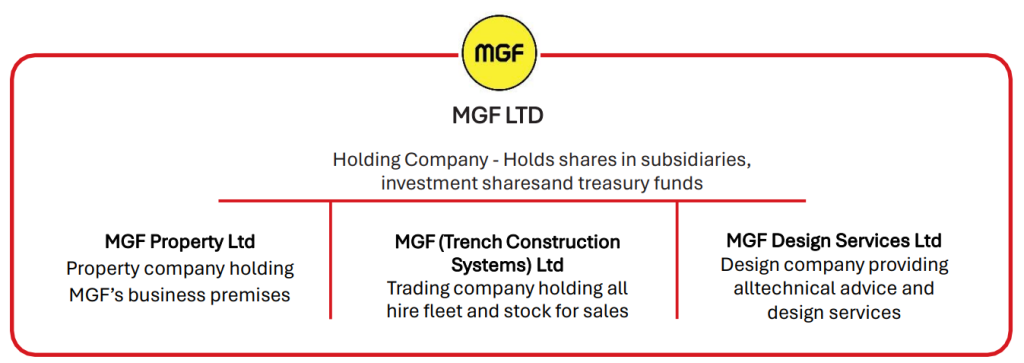
MGF Ltd as the parent holding company has the ultimate responsibility for the corporate governance of the MGF group of companies. The Directors of MGF Ltd have approved this Modern Slavery Statement. Furthermore, two of the Directors of MGF Ltd are also Directors of MGF Property Ltd, MGF (Trench Construction Systems) Ltd and MGF Design Services Ltd. As such there is a clear line of accountability and responsibility from MGF Ltd to subsidiary companies. MGF (Trench Construction Systems) Ltd perform all HR, SHEQ and Procurement functions for MGF group and, accordingly, are charged with effecting a robust approach to
tackling Modern Slavery in MGF. A working group, reporting to the Board of Directors, led by the HR Director, and comprising HR, Procurement and Quality Managers has been created to formulate plans and undertake due diligence in MGF’s supply chains.
Modern Slavery Statement
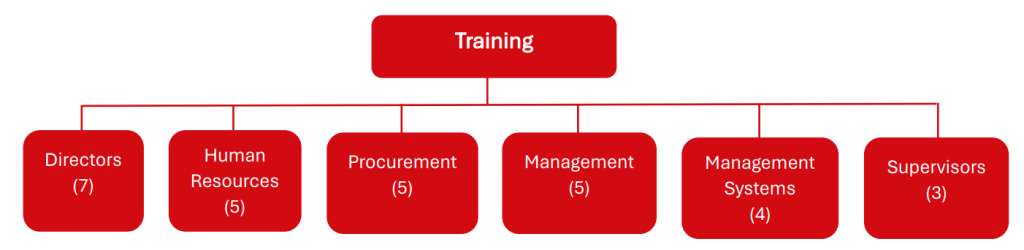
Raising awareness and building capacity in our business and supply chains is an important part of our strategy for developing a robust approach for tackling modern slavery. Further upskilling of key staff has been undertaken in the period utilising resources available through the construction industry’s Supply Chain Sustainability School and iHASCO e-learning platform. In 2021 we have implemented our My Great Future training platform to further develop our staff awareness.
Our Supply Chain
In the reporting period MGF traded with 647 suppliers:
‣ Steel Fabrication – 15
‣ Steel – 15
‣ Travel – 4
‣ Utilities – 7
‣ Consumables – 24
‣ Professional Services – 115
‣ Vendors <£2k – 229
‣ Oil/Fuel – 10
‣ Plant/Haulage – 61
‣ Products – 65
‣ Infrastructure – 74
As in the previous reporting period (2023/24), by far the largest proportion of spend by value was from 15 companies supplying steel sections and piles for in-house manufacture, hire and sale. In respect of steel supply MGF adopt a policy of only buying from European mills, this policy also extending to steel supply from stockholders and fabricators.
‣ In-house manufacture was supported through use of 15 local steel fabricators which has increased from 10 in the previous year.
‣ Infrastructure including capital investment, property maintenance and rentals involved service from 74 suppliers.
‣ Haulage, vehicle repair and maintenance together with oil and fuel involved a total of 61 suppliers.
‣ 115 suppliers were categorised as Professional Services and included legal and financial services, insurance, subscriptions, and training services.
‣ Utilities including electricity, gas, water, and telecoms accounted for 7 suppliers.
‣ Manufactured (proprietary) products were obtained from 66 suppliers.
Some 229 suppliers with purchase values of less than £2k were used in the period. In the main these were one-off purchases from local suppliers to meet short-term business needs. This has reduced from 252.
Policies in Relation to Modern Slavery
MGF recognise that modern slavery sits within a broad human rights agenda as embodied in a number of important declarations, standards, and codes. Through review of the sources of reference and guidance, and indeed the approaches adopted by leading companies, we have reviewed our existing policy framework to ensure that we are able to bring an effective response to our obligations in respect to modern slavery.
‣ The UN Universal Declaration of Human Rights.
‣ The international Labour Organisation (ILO) Declaration on Fundamental Principles and Rights at Work.
‣ The UN Guiding Principles on Business and Human Rights.
‣ Modern Slavery Act 2015.
‣ UK Government Home Office – Transparency in Supply Chains etc. A Practical Guide.
‣ Walk Free Foundation, Global Slavery Index. globalslaveryindex.org/
‣ Walk Free Foundation, Tackling Modern Slavery in Supply Chains.
‣ Stronger Together, Tackling Modern Slavery in SupplyChains. stronger2gether.com
‣ CORE Coalition, Practical Guides. corporate-responsibility.org/publications/practical-guides/
‣ Supply Chain Sustainability School, Modern Slavery Resources. supplychainschool.co.uk
‣ Modern Slavery Registry. modernslaveryregistry.org/
‣ TISCReport. tiscreport.org/
‣ Ethical Trading Initative Base Code Guidance: Modern Slavery
‣ RESPECT International ResourceCentre.
MGF Policies and Documents Relevant to Modern Slavery
MGF Making Great Futures, together with MGF RESPECT Ground rules and Staff Handbook set-out our relationships with our People, our Customers, the Environment, and the Communities in which we operate. Furthermore, through the effective implementation of our existing policies and practices, particularly in the area of Human Resources, we are able to provide full assurance that there is no modern slavery in our business.
Notwithstanding this, we acknowledge that we have some way to go to provide full transparency and build capacity in our supply chains to provide assurance there is no risk of modern slavery or human trafficking.
‣ MGF Making Great Futures
‣ MGF Staff Handbook
‣ MGF RESPECT Groundrules
‣ Anti- Bribery
‣ Whistle Blowing
‣ Competition Law Compliance Policy
‣ Equality and Diversity
‣ Right to Work in UK
‣ Modern Slavery Policy Statement
‣ Sustainable Procurement Policy
‣ Selection and Approval of Suppliers
‣ Supplier Approval Questionnaire
‣ Contractor Pre-Qualification Questionnaire
‣ External Haulier Pre-Qualification Questionnaire
‣ Sustainability Policy
‣ Bullying and Harassment Policy
‣ Modern Slavery Act Supplier Questionnaire
Risk Assessment in Our Supply Chains
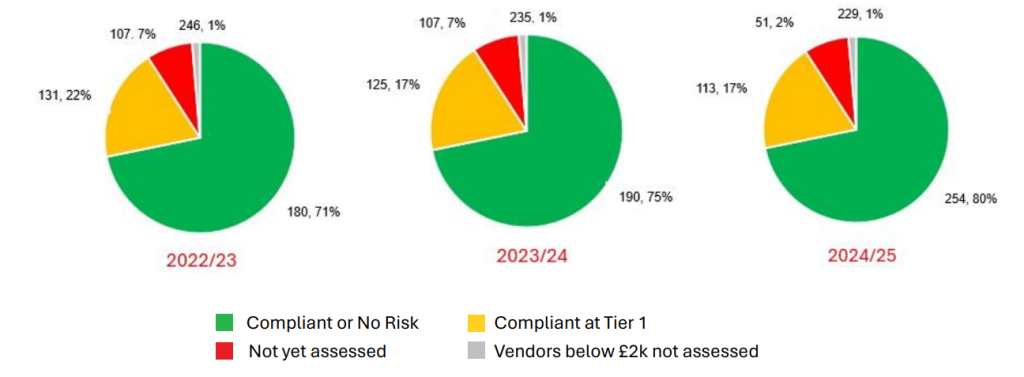
Our primary effort in the reporting period has been to increase the level of engagement with our supply chains with the aim of improving transparency and increasing the proportion of suppliers deemed as Compliant or No Risk and compliant at Tier 1 level.
In the reporting period 2024/25, 254 suppliers amounting to 80% of total spend have been assessed as either compliant to the Modern Slavery Act, or, at no risk of modern slavery. This percentage has increased compared to 2024/25 reporting period.
Compliant suppliers tend to be large and often multi-national companies who have adopted a satisfactory approach and who publish their own Modern Slavery Statements on the Modern Slavery Registry. It should also be noted that MGF have no leverage over these large companies. Suppliers assessed as at no risk of modern slavery include, for example, professional services and property rental.
113 suppliers amounting to 17% of total spend have been assessed by MGF as compliant at Tier 1 but where more work is required to provide assurance further down the supply chain. This has decreased when compared to 2023/24 reporting period.
51 suppliers amounting to 2% of total spend have yet to be assessed or following initial assessment have work to do to demonstrate compliance at Tier 1 level which has remained the same compared to the previous reporting period.
229 suppliers with spend of less than £2k per annum have yet to be assessed, but these smaller suppliers amount to only 1% of total spend.
Plans for 2025/26
Modern slavery approval is now central to our supply chain approval process. We will continue to review and monitor the effectiveness of all our supply chain in order to provide full assurance that there is no risk of modern slavery and human trafficking. Accordingly, the main activity for 2025/26 will again centre on engagement with our supply chains and capacity building activity. Another focus is to continue to improve the knowledge of our staff on the issue through platforms such as the construction industry’s Supply Chain Sustainability School.